If you’re looking for somewhere to stretch your legs this winter, look no further than the Kilburn Mill at Clark’s Cove. The former textile mill spans 470,000 square feet with plenty to explore along the way. Weave through artist studios, artisan shops and galleries, fitness and wellness centers, and pieces of textile history on display. On the ground floor, a massive antique mall filled with artifacts of New Bedford’s past could occupy hours of your time. When you need a refresh, visit Society Coffee Bar right at the front entrance to the artisan center. On nice days, step outside for a walk along the Cove Walk, accessible from the Kilburn Mill’s parking lot. This experience qualifies as cozy cardio, with a sensory-rich environment, low-impact exercise, and a pace of your choosing.
New Bedford’s Textile Boom
In its early years as a city, New Bedford’s economic prosperity was driven by its primacy in the whaling industry. After the industry’s decline in the later part of the nineteenth century, developers looked towards the industry on the rise, textiles. Although the textile industry was present in New Bedford before the decline of whaling, its rapid growth was prompted by the shift in production demand.
In 1847, the same year New Bedford became incorporated as a city, the Wamsutta Mills were established on the Acushnet River. Over the years, subsequent buildings were added to the Wamsutta Mills, and by 1892, it was the largest cotton weaving factory in the world. In the 1880s, mill development was rapid throughout the city. There were as many as seventy mills operating at one time. In 1904 The Kilburn Mill was built under the management of Henry L. Tiffany. Tiffany was an executive with the New England Cotton Yarn Company and family relation to New York’s jewelry mogul.

The Kilburn Mill’s Story
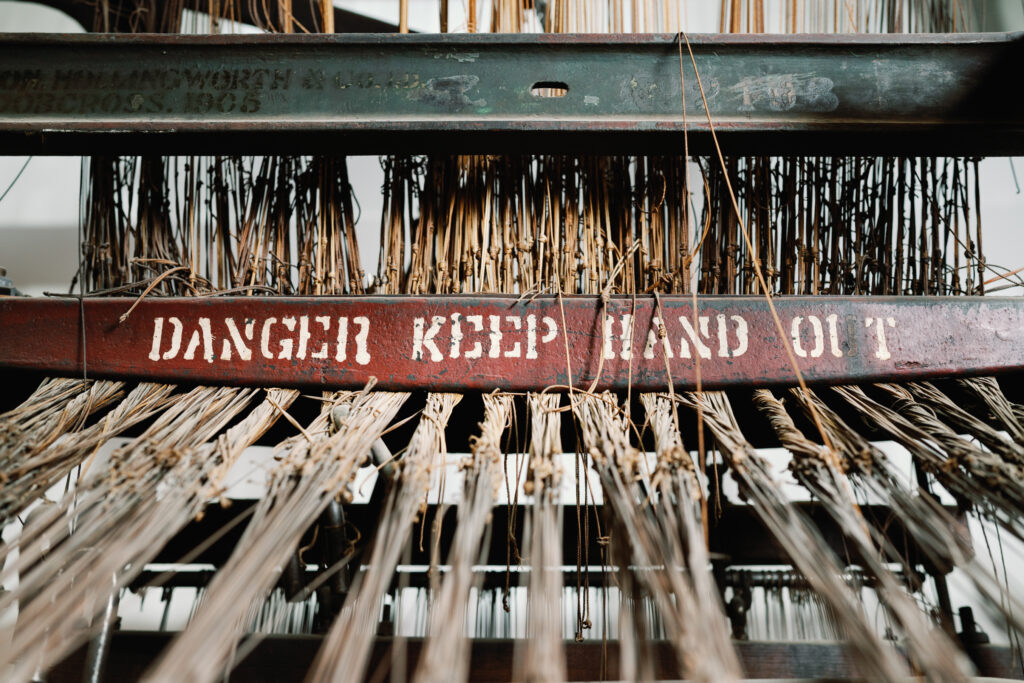
The Kilburn Mill became a major cotton textile spinning mill. Raw cotton was spun into thread and then shipped to other mills in the city, where it was woven into fabric panels. At its peak, the mill was one of the city’s largest employers. As was typical of the textile boom, a steady supply of workers was required to keep up with production demand. Immigrants came in to work from Portugal, French-Canada, Ireland, England, Poland, and Cape Verde. New Bedford’s population grew to 104,000 people between 1910 and 1915. First or second generation immigrants comprised eighty-four percent of that total population. The work conditions were grueling and, consequently, resulted in strikes and protests. Many of these strikes were led by inspiring women activists in New Bedford.
As the textile mill era started to decline, many mill buildings fell into disuse or were repurposed. In 2006, New Bedford Antiques at the Cove opened in the mostly vacant Kilburn Mill building. It was the only attraction up until 2018 when the third-floor event space was renovated.
Historic Renovations
In July 0f 2018, visitors stepped into a historical moment where the past, present, and future of the mill coexisted. Subsequently, they were able to witness historic renovation in place, passing sectioned off rooms still containing remnants of the past. Historic elements were maintained in the process, including hardwood floors, brick walls, and large thirteen-foot high windows overlooking Clark’s Cove.
The Country’s Longest Painting
Stepping onto the sprawling third-floor event space, viewers also got the first glimpse in most of their lifetimes of the Grand Panorama of a Whaling Voyage ‘Round the World. The New Bedford Whaling Museum oversaw a decades-long, careful and innovative restoration of the 1848 painting by New Bedford artists Caleb Purrington and Benjamin Russell. This showing at the Kilburn Mill was the first time in generations that the panorama was on full display, winding its 1,275 feet up and down the space several times. Learn more about the exhibit and the longest painting in the country.
Kilburn Today

Today, the Kilburn Mill is filled with over 100 tenants, including artist studios, shops, wellness studios, and professional workspaces. The mill makes for a unique shopping and sightseeing excursion that will also help you get in some exercise. But if you do decide to opt for an additional challenge, check out the fitness and wellness studios in residence before you visit. Browse the Kilburn Mill website for more information.